
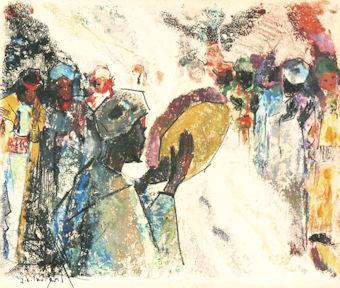

Technique mixte sur panneau
Cachet de l’atelier
77 x 62 cm
Cette oeuvre figure à la page 66 sous le n°202 du catalogue raisonné de Mohammed Kacimi, Tome 1, Nadine Descendre, ART’DIF Éditions.
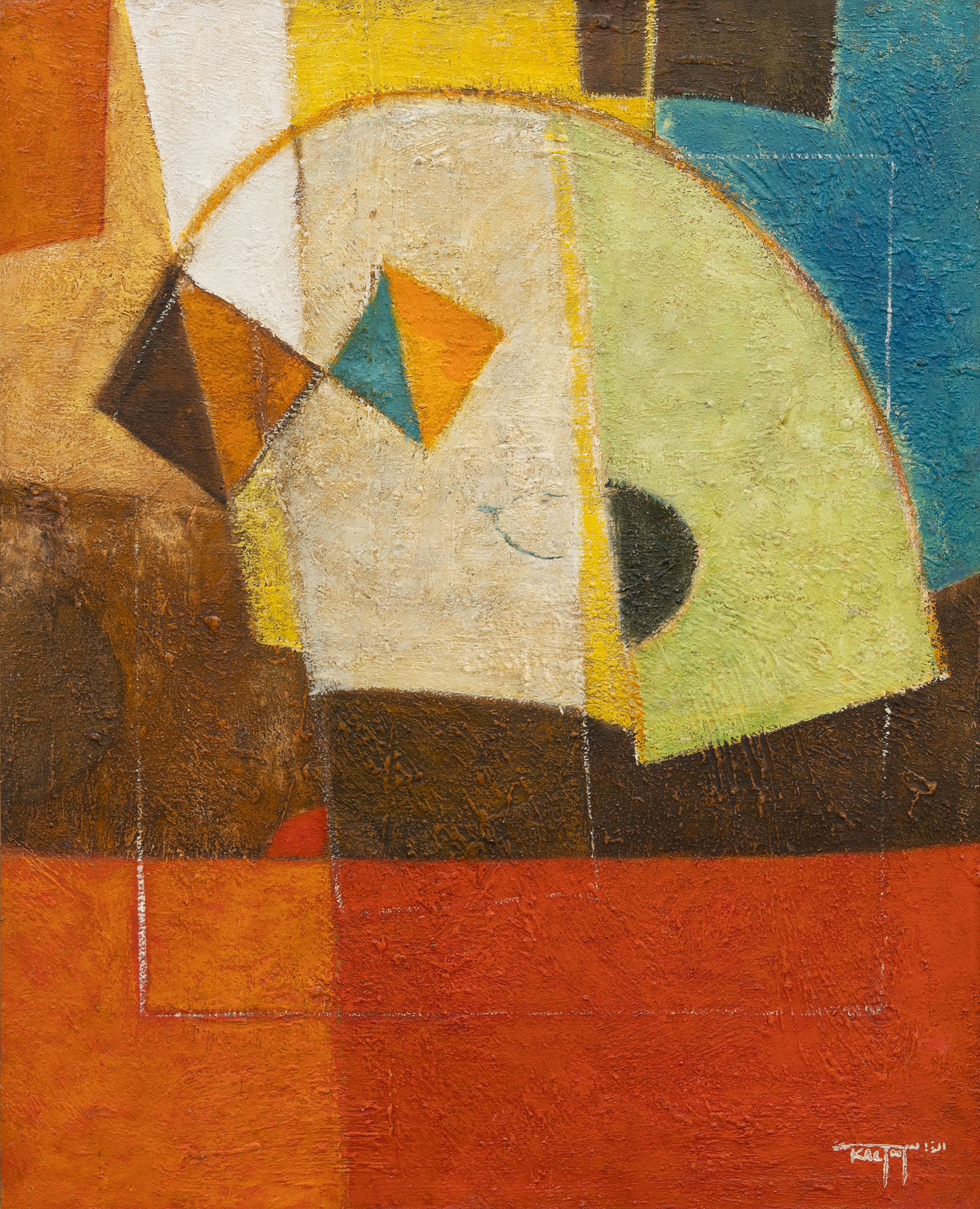
Réalisée au lendemain de la Biennale de Bagdad et des voyages effectués par Mohamed Kacimi au Liban et en Palestine, cette oeuvre témoigne d’un moment charnière dans son parcours. Sans céder à la représentation narrative, l’artiste intègre à son vocabulaire plastique les préoccupations politiques et humaines qui marqueront durablement son oeuvre.
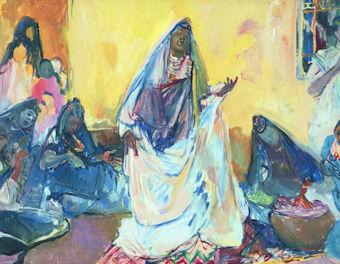
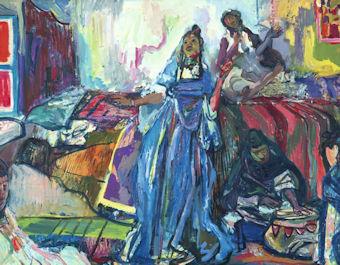
La géométrisation croissante de la composition organise l’espace en compartiments, tensions et frontières. Les formes semblent contraintes dans une architecture rigoureuse qui évoque l’enfermement, la fragmentation des territoires et la condition précaire des populations déplacées vivant dans les camps. Cette construction spatiale contraste avec la sensibilité de la matière picturale, qui conserve une dimension profondément humaine.
La palette participe également de cette lecture. Les rouges, les verts, les noirs et les blancs qui structurent l’oeuvre font discrètement écho aux couleurs associées à la Palestine, transformées ici en éléments plastiques plutôt qu’en symboles explicites. Kacimi refuse l’illustration militante pour privilégier une évocation plus universelle de l’exil, de l’attente et de la dépossession.
Cette toile marque ainsi l’émergence d’une conscience politique qui lie plusieurs artistes disctincts du monde arabe autour de la question palestinienne.
Mixed media on panel
Studio stamp
77 x 62 cm
This work is listed on page 66 under no. 202 in the catalogue raisonné of Mohammed Kacimi, Volume 1, by Nadine Descendre, published by ART’DIF Éditions.
Created in the wake of the Baghdad Biennale and Mohamed Kacimi’s travels to Lebanon and Palestine, this work marks a turning point in his career. Without resorting to narrative representation, the artist incorporates into his visual vocabulary the political and human concerns that would leave a lasting mark on his work.
The increasing geometrisation of the composition organises the space into compartments, tensions and boundaries. The forms appear constrained within a rigorous architecture that evokes confinement, the fragmentation of territories and the precarious condition of displaced populations living in camps. This spatial construction contrasts with the sensitivity of the pictorial material, which retains a profoundly human dimension.
The colour palette also contributes to this interpretation. The reds, greens, blacks and whites that structure the work discreetly echo the colours associated with Palestine, transformed here into visual elements rather than explicit symbols. Kacimi rejects militant illustration in favour of a more universal evocation of exile, waiting and dispossession.
This painting thus marks the emergence of a political consciousness that unites several distinct artists from the Arab world around the Palestinian question.
Rapport de condition